Sealed, balanced ductwork for lower bills and cleaner air
Air duct cleaning azusa CA that stops the leaks
If your AC runs all afternoon and the rooms still feel uneven, the problem is usually the ductwork, not the equipment. We provide air duct cleaning azusa CA homeowners call when supply runs leak into attics and dust keeps landing on the furniture. Our crew cleans every trunk line and branch run, then seals the joints with mastic and foil tape so the air you paid to cool actually reaches the rooms. We serve houses, condos, and small commercial spaces across Los Angeles County.
Air duct cleaning azusa CA is a mechanical and sealing service that removes built-up dust, debris, and microbial growth from your supply and return ductwork, then closes the gaps that let conditioned air escape. We run a negative-air vacuum through the system while rotary brushes and compressed-air whips scrub the interior walls of each run. Every register and return grille comes off, gets washed, and goes back on. On the sealing side, we brush mastic onto every accessible joint, collar, and plenum connection, then wrap the seams with foil tape rated for the temperatures your attic hits in August.
Most Azusa homes were built between the 1950s and the 1990s, and a lot of them still run the original sheet-metal ductwork with taped joints that dried out years ago. Add the San Gabriel Valley dust that blows down off the foothills, and you get duct runs that are both dirty and leaky at the same time. That is why we almost never recommend cleaning without sealing. If you have been searching for duct cleaning and sealing azusa CA, you want both jobs done in one visit so the dust you just removed does not get pulled straight back in through an open seam.
Every job includes the full cleaning and sealing scope below. If your system needs a new run or a replacement section, we quote that separately before we start, so there are no surprises on the invoice.
01
✓
Full supply and return cleaning
We clean every supply branch and every return run, not just the main trunk. Rotary brushes and compressed-air whips scrub the interior walls, and a negative-air vacuum pulls the loosened debris out of the system. Every register and grille is removed, washed, and reinstalled.
02
✓
Joint and seam sealing
We brush mastic onto every accessible joint, collar, plenum connection, and boot, then wrap the seams with foil tape rated for attic temperatures. This is the step that stops the leaks and keeps the system holding pressure after we leave.
03
✓
Register and grille cleaning
Supply registers and return grilles collect dust on the vanes and behind the frame. We pull each one, wash it, and reinstall it. If a grille is bent or a damper is stuck, we note it and can replace it on the same visit.
04
✓
Filter replacement
We install a fresh filter sized to your air handler and note the size for you. A clean duct system with a clogged filter is a waste of money, so we make sure the filter is matched and seated correctly before we button up the system.
05
✓
Airflow verification
After cleaning and sealing, we re-measure static pressure and check airflow at each register. You get the before and after numbers. If a run is still underperforming, we investigate and correct it before we call the job done.
How it works
How our duct cleaning and sealing process works
We start with a full walkthrough of the duct system, including the attic, crawlspace, and any accessible chases. We check for crushed flex runs, disconnected collars, water damage, and pest intrusion. We also measure static pressure at the air handler and note the register count. This takes 20 to 30 minutes and tells us whether cleaning and sealing will fix the problem or whether a section of ductwork needs replacing.
We connect a high-volume negative-air vacuum to the main trunk line and seal off the registers we are not actively working. This keeps the whole system under negative pressure so loosened debris travels to the vacuum instead of into your living space. We lay drop cloths on the floors and wear shoe covers. Setup runs about 30 minutes on a typical single-story Azusa home.
Working run by run, we feed rotary brushes and compressed-air whips through each branch line to scrub the interior walls. Return ducts get the same treatment. Every supply register and return grille is removed, washed, and set aside. On a 1,800-square-foot house with 12 to 14 registers, the cleaning phase takes two to three hours.
Once the system is clean, we seal it. We brush mastic onto every accessible joint, collar, plenum connection, and boot, then wrap the seams with foil tape. Disconnected flex runs get reconnected and clamped. Crushed sections get replaced. We also check the filter grille and the air handler cabinet for gaps. Sealing adds roughly 90 minutes to the visit.
We reinstall every register, restore the system, and run it. Then we re-measure static pressure and check airflow at each register to confirm the numbers improved. You get a walkthrough of what we found, what we sealed, and what to watch going forward. If we replaced a filter, we note the size so you can buy the right one next time.
STEP 01System inspection
We start with a full walkthrough of the duct system, including the attic, crawlspace, and any accessible chases. We check for crushed flex runs, disconnected collars, water damage, and pest intrusion. We also measure static pressure at the air handler and note the register count. This takes 20 to 30 minutes and tells us whether cleaning and sealing will fix the problem or whether a section of ductwork needs replacing.
Tools & methods
Tools and methods we use on every job
01
✓
Negative-air vacuum
Pulls the entire duct system under negative pressure so loosened debris travels to the vacuum instead of into your living space. This is the core piece of equipment on every cleaning job.
02
✓
Rotary brush system
Flexible shafts with brush heads that scrub the interior walls of each duct run. We use different brush sizes for trunk lines and branch runs so the full interior surface gets contacted.
03
✓
Compressed-air whip
Forward and reverse air nozzles that knock debris off duct walls and push it toward the vacuum. Used together with the rotary brush on heavily contaminated runs.
04
✓
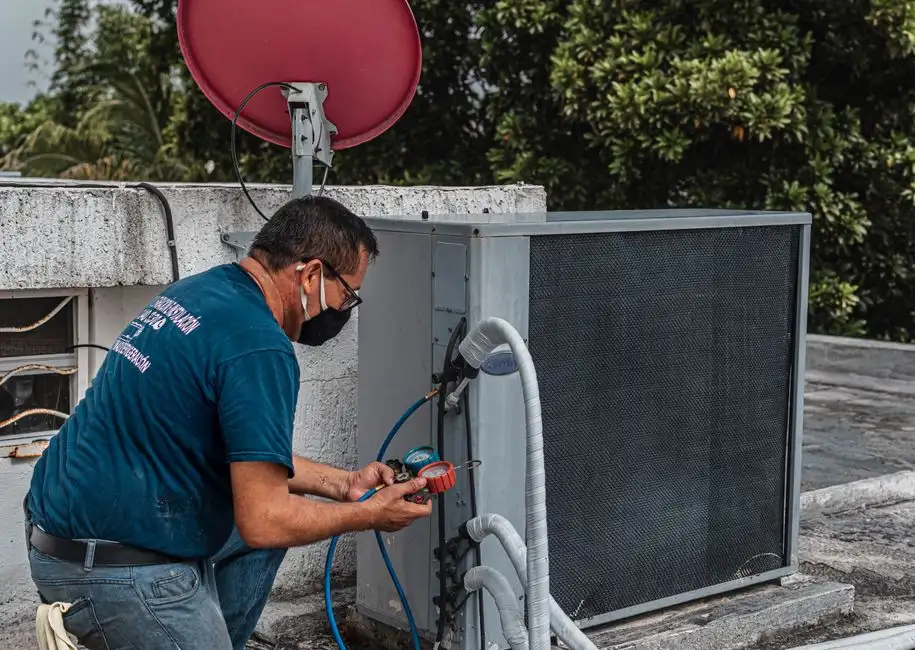
Manifold gauge set
Lets us check refrigerant pressures on the equipment side when a duct problem turns out to be a charge problem. We carry it on every call so we can diagnose the whole system, not just the ducts.
05
✓
Micron gauge and leak detector
Used when we suspect a refrigerant leak is contributing to poor cooling. A duct system can only deliver the capacity the equipment is actually producing.
06
✓
Psychrometer
Measures temperature and humidity at the return and supply so we can calculate the actual temperature split. This tells us whether the system is cooling the air the way it should.
Real results
Before and after.
Air Duct Cleaning & Sealing
Disconnected flex runs in North Azusa attic
A 1,700-square-foot house with two back bedrooms that never cooled. The attic had two flex runs pulled completely off their collars, dumping cold air into the attic. Static pressure at the air handler was high, and the system ran almost continuously from noon to 8 p.m.
After: We cleaned every run, reconnected and clamped the two disconnected flex runs, and sealed all accessible joints with mastic and foil tape. Static pressure dropped by roughly 0.25 inches of water column, and both back bedrooms reached the thermostat setting within an hour of the system running.
Dusty 1960s sheet-metal system near Downtown Azusa
Original sheet-metal ducts with failed tape at every joint. Dust was visible on furniture within a day of cleaning, and the return grille was coated with a thick layer of debris. The homeowner had allergies and noticed symptoms getting worse indoors.
After: We removed years of accumulated dust from every supply and return run, washed all registers, and sealed every joint and collar with mastic and foil tape. The dust on furniture dropped off within a week, and the homeowner reported fewer allergy symptoms at night.
Crushed flex duct in Azusa Pacific University area rental
A rental unit where the front room was always hot and the back room was always cold. A storage box had been set on top of a flex run in the attic, crushing it almost flat. Airflow at the front register was less than half of what it should have been.
After: We replaced the crushed section of flex duct, cleaned the full system, and sealed the joints. Airflow at the front register came back to normal, and the temperature difference between the two rooms dropped from about 8 degrees to under 2 degrees.
Most duct complaints come down to a short list of problems. We see the same ones across Azusa, and we know how to fix each without replacing the whole system.
We clean every supply and return run, then seal the joints so new dust cannot be pulled in from the attic or crawlspace. We also check the filter grille and air handler cabinet for gaps that let unfiltered air into the system.
↗02
Rooms that never reach the thermostat setting
We measure airflow at every register and find the underperforming runs. Usually the problem is a crushed flex duct, a disconnected collar, or a run that was never sized correctly. We repair or replace the run and balance the system so every room gets its share of air.
↗03
High summer cooling bills
Sealing the joints, collars, and plenum connections recovers most of that lost air. We verify the improvement with static pressure readings before and after, so you can see the system is holding pressure instead of leaking it.
↗04
Musty or stale smell when the AC runs
We clean the affected runs, address any moisture source we find, and seal the system so humid attic air stops entering the ductwork. If the evaporator coil or drain pan is the source, we clean those on the same visit.
↗
Proof you can check
Licensed, certified, and reviewed
California Contractor License C-20 (HVAC) · California Contractors State License Board
EPA Section 608 Universal Certification · U.S. Environmental Protection Agency
NATE Certification · North American Technician Excellence
ACCA Manual D · Air Conditioning Contractors of America
Title 24 Compliance · California Energy Commission
Customer reviews
What Azusa customers say
★★★★★
“We had dust on everything within a day of cleaning, and the back bedrooms never cooled. The crew found two disconnected flex runs in the attic and sealed the whole trunk line. The dust stopped within a week, and the back rooms finally hit the thermostat setting. They showed me the static pressure readings before and after, which I appreciated.”
MR
Maria R.Homeowner, North Azusa
✓ Verified
“
★★★★★
“Our house is from the 1960s and still had the original sheet-metal ducts. They cleaned every run and sealed the joints with mastic. Our summer bill dropped noticeably, and the house holds temperature better during the hottest part of the day. Fair price, no upsell, and they cleaned up after themselves.”
DK
Daniel K.Homeowner, Azusa Foothills
✓ Verified
★★★★★
“My son has allergies and the apartment ducts had never been touched. They cleaned the supply and return, replaced the filter, and sealed the register boots. His sneezing at night dropped off within two weeks. They were careful with the furniture and finished in about three hours.”
Most Azusa homes run $350 to $800 for cleaning and sealing together, depending on register count and system size. A single-story house with 10 to 12 registers usually lands near the lower end. Two-story homes, homes with multiple systems, or systems with heavy contamination and pest debris run higher. We give you a flat price before we start, so you know the number before any work begins.
Every three to five years for most Azusa homes, and sooner if you have pets, recent remodeling, or visible dust blowing from the registers. Homes near the foothills deal with more airborne dust, so we sometimes recommend every two to three years. If you have never had the ducts cleaned and the house is more than 15 years old, book an inspection first and we will tell you honestly whether cleaning is needed.
Yes, and it is usually the bigger win of the two services. Sealing leaky joints and collars typically recovers 15 to 25 percent of the air your system is losing into the attic or crawlspace. That air is already cooled, so recovering it means your compressor runs shorter cycles to hit the same thermostat setting. On a 2,000-square-foot Azusa home, that often shows up as a noticeable drop in summer cooling cost.
We do both in a single visit, which is how it should be done. Cleaning without sealing leaves the system open to new dust, and sealing without cleaning traps debris inside the runs. We clean every supply and return, then seal the joints, collars, and plenum connections with mastic and foil tape. Call (626) 765-0724 and we can usually schedule same-day or next-day service.
If your system is blowing dust, your rooms never balance out, or you just want the ducts clean before summer, call us. We give you a flat price, show up on time, and verify the airflow before we leave. Same-day and 24/7 slots are available across Azusa and Los Angeles County.
Call (626) 765-0724 or email info@azusabreezehvac.com and we will get you on the schedule. We answer the phone seven days a week, run emergency calls around the clock, and aim to have a tech at your door the same day for no-cool calls across Azusa and Los Angeles County.